Complete Guide to HVAC Design for Construction (2025-2026)
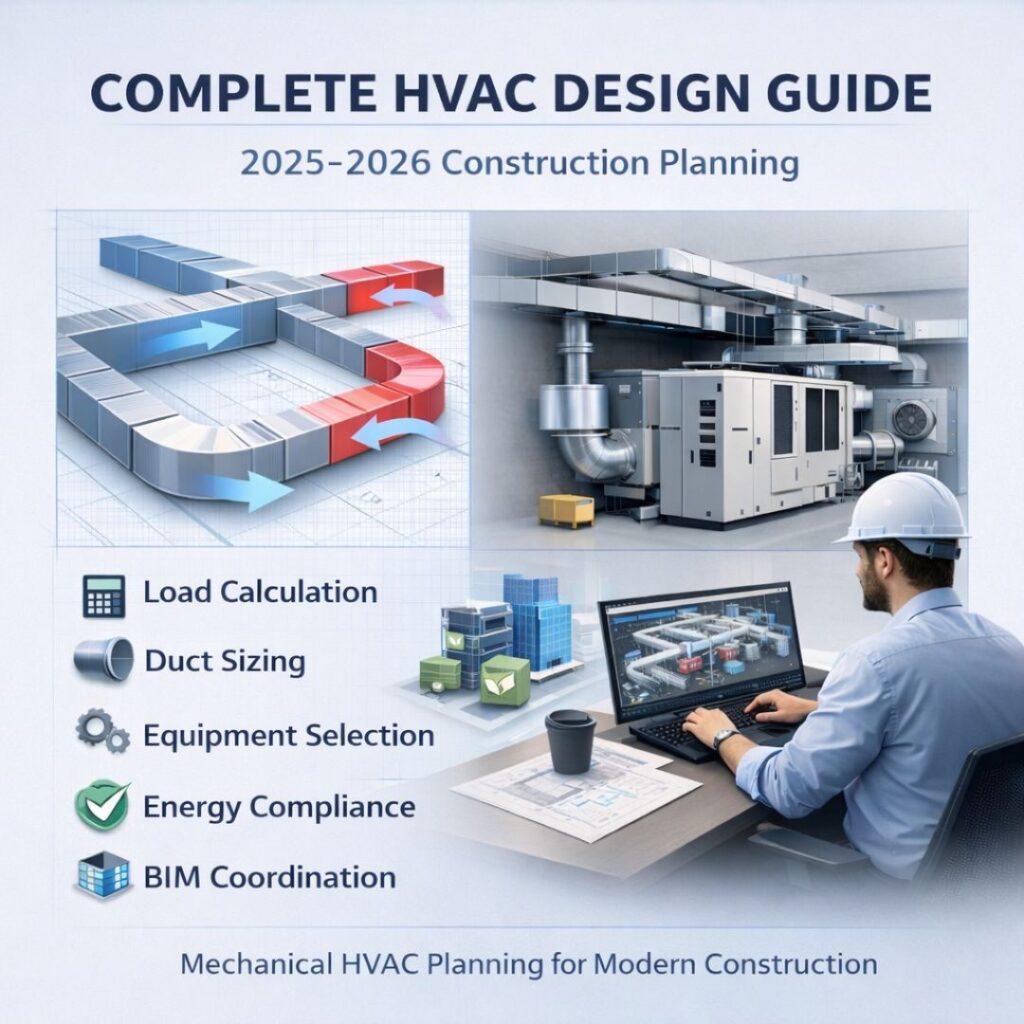
Modern construction in 2025–2026 demands more than just structural strength and architectural beauty. Buildings today must be energy-efficient, environmentally responsible, technologically integrated, and comfortable for occupants. This is where HVAC design for construction becomes critically important. A well-planned HVAC system is the backbone of indoor comfort and operational efficiency.
Whether you are developing a commercial complex, hospital, data center, or residential tower, following a structured HVAC system design guide ensures compliance, cost savings, and long-term performance. At INFRAVISEDESIGN, we specialize in advanced HVAC planning for new construction, delivering sustainable and high-performance systems tailored to modern building needs. Our team also leverages MEP BIM coordination Ahmedabad to improve system integration, detect clashes early, and ensure seamless coordination between mechanical, electrical, and plumbing services during the design stage.
This complete guide explains everything — from the HVAC design process step by step to duct calculations, standards, trends, and future insights.
Introduction to Complete Guide to HVAC Design for Construction (2025–2026)
HVAC design for construction is the engineering process of planning heating, ventilation, and air conditioning systems before a building is constructed. It involves load analysis, equipment selection, airflow planning, duct sizing, and compliance with HVAC design standards for commercial buildings and residential codes.
In 2026, buildings are expected to meet strict energy regulations and sustainability goals. A simple installation approach is no longer acceptable. Instead, developers require a comprehensive HVAC system design guide that covers performance, lifecycle cost, and energy efficiency. Poor planning can lead to oversized equipment, uneven cooling, high electricity bills, and maintenance challenges.
At INFRAVISEDESIGN, our team follows a detailed mechanical HVAC design checklist to ensure every project meets technical, environmental, and financial objectives. From HVAC duct design calculation to smart automation integration, each stage is executed with precision. Our approach combines engineering expertise with modern HVAC design software for engineers, ensuring accurate and coordinated drawings within BIM environments.
A well-designed HVAC system not only controls temperature but also enhances air quality, humidity balance, and occupant comfort. That is why professional HVAC planning for new construction is a strategic investment, not an expense.

Why HVAC Design for Construction Matters in 2026
The importance of HVAC design for construction has significantly increased in 2026 due to evolving building codes, energy regulations, and sustainability targets. Governments worldwide are implementing stricter policies to reduce carbon emissions and improve energy efficiency. Without proper energy efficient HVAC design, projects risk non-compliance and financial penalties.
Rising electricity costs are another major factor. Buildings with poor HVAC system design guide implementation often experience excessive operational expenses. Oversized chillers, improperly designed ducts, and inefficient air distribution systems can increase energy consumption by 20–30%. A structured HVAC design process step by step prevents such inefficiencies.
Indoor air quality has also become a top priority. Modern commercial buildings, hospitals, and educational institutions require advanced filtration and ventilation systems. Following HVAC design standards for commercial buildings ensures compliance with international safety and health norms. To achieve these standards effectively, many developers rely on professional HVAC design services Ahmedabad that focus on efficient ventilation planning, air quality control, and energy-optimized HVAC system performance.
Additionally, smart buildings are becoming the new standard. Integration with building management systems requires accurate planning using professional HVAC design software for engineers. At INFRAVISEDESIGN, we incorporate automation-ready solutions into every HVAC planning for new construction project, ensuring scalability and future adaptability.
In short, proper HVAC design for construction directly impacts energy savings, occupant health, sustainability ratings, and overall project success.
Key Benefits of Professional HVAC Design for Construction
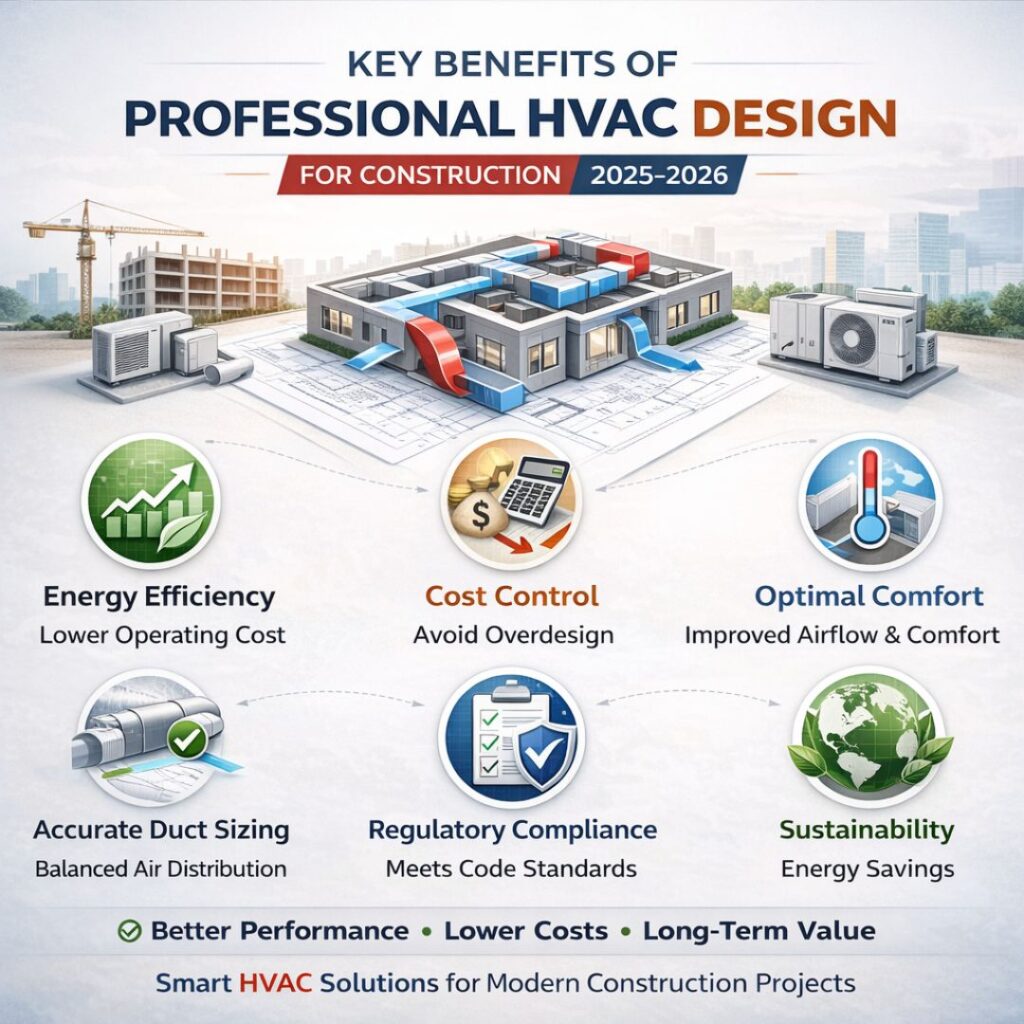
Investing in professional HVAC design for construction delivers measurable technical and financial benefits. A structured HVAC system design guide ensures that each component operates efficiently and harmoniously within the building ecosystem.
One of the most important advantages is optimized energy performance. Through accurate HVAC duct design calculation, engineers minimize pressure losses and ensure balanced airflow. This directly reduces fan power consumption and enhances system efficiency. Combined with energy efficient HVAC design strategies, buildings can significantly reduce electricity bills over their lifecycle.
Another major benefit is cost control. A proper HVAC design process step by step eliminates overdesign and equipment oversizing, while coordinated electrical design for construction ensures that power distribution, load balancing, and system capacity are planned accurately. This reduces initial capital expenditure and avoids unnecessary operational costs. For residential projects, efficient HVAC design for residential buildings ensures comfort without excessive system capacity.
Compliance is also a critical benefit. By following HVAC design standards for commercial buildings, developers avoid inspection delays and regulatory issues. Additionally, integration with BIM using advanced HVAC design software for engineers improves coordination between mechanical, electrical, and structural systems.
At INFRAVISEDESIGN, our experience shows that a well-documented mechanical HVAC design checklist can reduce long-term maintenance costs by up to 25%. This proves that investing in professional HVAC engineering is not just about comfort — it is about long-term value creation.
HVAC Design Process Step by Step (2025–2026 Edition)
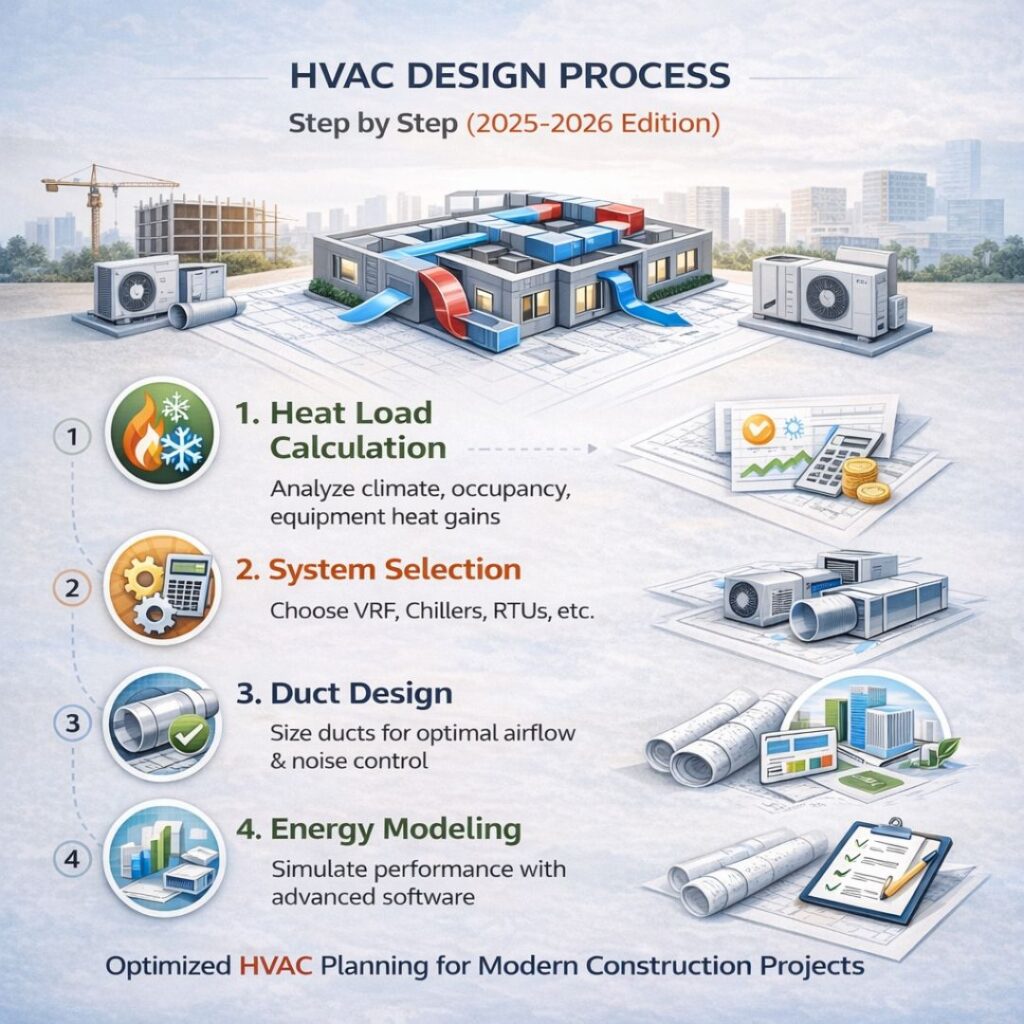
Understanding the HVAC design process step by step is essential for successful project execution. Every stage of HVAC design for construction builds upon technical calculations and engineering standards.
The first step is heat load calculation. Engineers analyze climate conditions, building orientation, occupancy levels, lighting loads, and equipment heat gains. Accurate load calculation forms the foundation of a reliable HVAC system design guide.
The second step involves system selection. Based on project requirements, engineers choose appropriate systems such as VRF, chilled water systems, rooftop units, or air handling units. Selection must align with energy efficient HVAC design principles.
The third stage is HVAC duct design calculation. Proper duct sizing ensures optimal airflow velocity, static pressure balance, and noise control. Poor duct planning can compromise overall system efficiency.
Next comes energy modeling and simulation using advanced HVAC design software for engineers. This step evaluates performance under different load conditions and identifies opportunities for efficiency improvements.
Finally, engineers verify compliance with HVAC design standards for commercial buildings and prepare documentation based on a complete mechanical HVAC design checklist. At INFRAVISEDESIGN, this systematic approach ensures accurate and future-ready HVAC planning for new construction projects.
HVAC Design for Residential vs Commercial Buildings
HVAC design for residential buildings focuses primarily on occupant comfort, cost efficiency, and space optimization. Residential systems require quieter operation, compact layouts, and simplified maintenance. Energy efficiency remains important, but system complexity is generally lower compared to commercial buildings.
In contrast, HVAC design standards for commercial buildings demand more advanced planning. Commercial spaces require zoning strategies, fresh air management, fire and smoke control integration, and sometimes data center cooling solutions. The HVAC system design guide for commercial buildings must address larger occupancy loads and operational hours.
For both sectors, structured HVAC planning for new construction is essential. Residential projects benefit from simplified yet efficient systems, while commercial buildings require scalable and automation-ready solutions.
At INFRAVISEDESIGN, our engineers tailor HVAC design for construction strategies based on project type. Whether designing a luxury residence or a high-rise commercial tower, we apply a detailed mechanical HVAC design checklist to ensure performance, compliance, and energy optimization.
Latest Trends & Insights in HVAC Design (2025–2026)
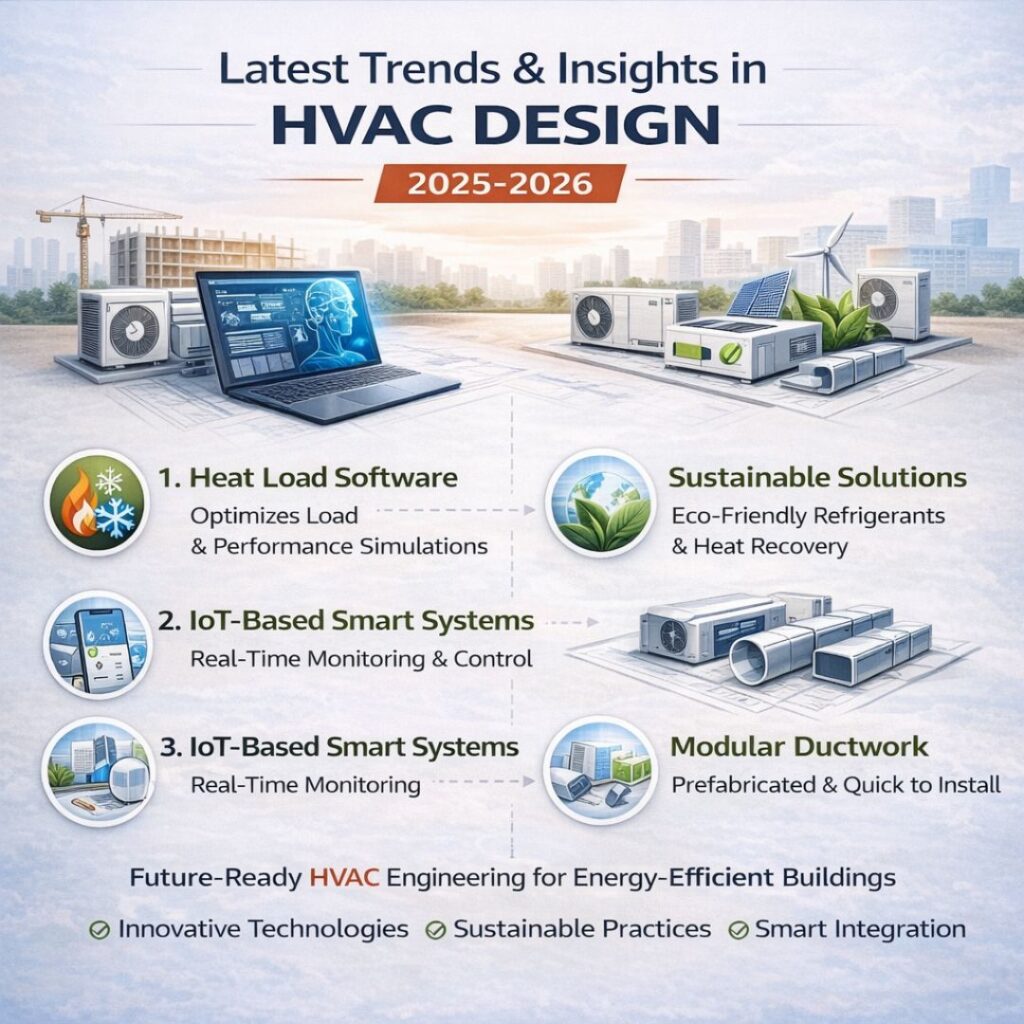
The field of HVAC design for construction is evolving rapidly in 2025–2026. Technological innovation and sustainability goals are reshaping industry practices.
Artificial intelligence is transforming HVAC design software for engineers. AI-powered simulations predict load variations and optimize system performance. This enhances the accuracy of HVAC duct design calculation and equipment sizing.
Sustainability is another major trend. Green refrigerants and advanced heat recovery systems are becoming standard in energy efficient HVAC design. Developers aiming for green certifications rely heavily on a structured HVAC system design guide.
IoT-enabled sensors allow real-time monitoring of temperature, humidity, and airflow. Smart systems integrated into HVAC planning for new construction improve maintenance scheduling and reduce downtime.
Modular and prefabricated duct systems are also gaining popularity. They simplify installation and reduce on-site errors. By following updated HVAC design standards for commercial buildings, engineers ensure compatibility with modern building technologies.
At INFRAVISEDESIGN, we integrate these innovations into every project, ensuring that our HVAC design for construction solutions are future-ready and aligned with global best practices.
Challenges in HVAC Design for Construction
Despite advancements, HVAC design for construction presents several challenges. One of the biggest issues is coordination between mechanical, electrical, and structural teams. Without integrated HVAC planning for new construction, clashes can cause costly delays.
Budget constraints often pressure engineers to compromise on system quality. However, cutting corners in the HVAC system design guide stage can result in long-term operational losses.
Space limitations in high-rise buildings also complicate HVAC duct design calculation. Improper routing may reduce ceiling heights or interfere with other services.
Compliance with evolving HVAC design standards for commercial buildings requires continuous learning and technical expertise. Engineers must stay updated with code revisions and sustainability guidelines.
Using modern HVAC design software for engineers helps address these challenges, but technical knowledge remains essential. At INFRAVISEDESIGN, our structured HVAC design process step by step minimizes risks and ensures smooth project execution.
Conclusion: Build Smarter with Professional HVAC Design
In 2025–2026, HVAC design for construction is a strategic component of building success. From HVAC duct design calculation to full-scale energy efficient HVAC design, every detail influences cost, comfort, and compliance.
A structured HVAC system design guide supported by a detailed mechanical HVAC design checklist ensures reliability and long-term savings. Whether you require HVAC design for residential buildings or advanced HVAC planning for new construction, professional engineering expertise is essential.
INFRAVISEDESIGN delivers high-performance, sustainable, and technically precise HVAC design for construction solutions tailored to modern industry demands.
F.A.Q.
HVAC design for construction refers to the complete planning, calculation, system selection, and layout development of heating, ventilation, and air conditioning systems in a building project. It begins with heat load calculation based on climate, occupancy, lighting, and equipment loads. Engineers then select suitable systems such as VRF, chillers, split units, or rooftop units depending on the building type. The process also includes duct design, equipment sizing, airflow balancing, and energy efficiency planning. Proper HVAC design ensures indoor comfort, code compliance, and optimized operating costs. In construction projects, accurate HVAC design prevents overdesign, reduces energy waste, and improves long-term building performance.
The HVAC design process follows a structured step-by-step methodology to ensure system efficiency and reliability. First, engineers perform heat load calculations to determine cooling and heating requirements. Second, they select the appropriate HVAC system type based on building size and usage. Third, ductwork design and air distribution planning are completed to ensure balanced airflow and noise control. Fourth, equipment selection is finalized with proper capacity sizing. Finally, energy modeling and compliance checks are conducted to meet local building codes. In modern construction projects, BIM coordination is also used to avoid clashes with structural and electrical systems, ensuring smooth installation and execution.
HVAC duct sizing is calculated based on airflow requirements, friction loss, velocity limits, and static pressure considerations. Engineers first determine required airflow (CFM or CMH) for each zone using heat load calculations. Then, duct size is selected using methods such as the Equal Friction Method, Static Regain Method, or Velocity Reduction Method. Proper duct sizing ensures balanced air distribution, reduced noise levels, and energy-efficient operation. Oversized ducts increase installation cost, while undersized ducts cause pressure drops and inefficient cooling. In construction projects, accurate HVAC duct design calculation improves indoor comfort and ensures system longevity.
Energy-efficient HVAC design is critical in modern construction because HVAC systems account for a major portion of a building’s energy consumption. Proper system sizing, high-efficiency equipment, insulation design, and smart controls significantly reduce operational costs. Sustainable HVAC planning also includes energy recovery systems, eco-friendly refrigerants, and optimized airflow management. Efficient HVAC systems lower electricity bills, reduce carbon emissions, and help meet green building certifications. In commercial and residential projects, energy-efficient HVAC design not only improves occupant comfort but also increases long-term property value and ensures regulatory compliance with updated building standards.
Several key factors influence HVAC system design in new construction projects. These include building size, occupancy levels, climate conditions, insulation quality, internal heat gains, and ventilation requirements. The type of building—residential, commercial, hospital, or data center—also determines system selection and capacity planning. Budget constraints and long-term operating costs are equally important considerations. Engineers must also account for regulatory standards, safety codes, and sustainability goals. Proper coordination with architectural and structural layouts ensures efficient duct routing and equipment placement. Considering these factors during the design stage ensures optimal performance and avoids costly redesigns later.